
 By
By Using the concept of the “principal contradiction” as my analytic tool,1 and “unequal exchange” as my theory of imperialism,2 I will present the history of imperialism in a very concentrated form, going from colonial imperialism, then neocolonial imperialism and neoliberal imperialism to the current renewed geopolitical struggle. At the end of the article, I focus on the renewed geopolitical struggle, and the crises this represents for the capitalist mode of production.
Colonialism and the birth of capitalism
It was Lenin, who in 1917 introduced the concept of “imperialism” in his book “Imperialism as the Highest Stage of Capitalism.”3 However imperialism, in the form of colonialism, is as old as capitalism.
The birth of capitalism, and the creation of the modern world was one process, stretching from the Italian city states in the mid-1400s, through the European colonization of the world in the following centuries, ending with the breakthrough of industrial capitalism in Britain in the beginning of the 19th century. It was the process of colonial exploitation and of settler-colonialism creating clones of Europe in North America, Australia, New Zealand, Algeria, Rhodesia, and South Africa, displacing and eliminating the original population.
A transfer of value — the essence of imperialism– was a necessary and integrated part of the rise of industrial capitalism in Europe. The silver and gold from Latin America became the coins, which stimulated the capitalist manufacture in Northwestern Europe, the so-called primitive accumulation. Sugar, coffee, cacao, tobacco, tea, and cotton – all the colonial products – produced by slaves and super-exploited labor and consumed in Europe and North America, was part of a global accumulation process which polarized the world-system in a center-periphery structure.
The core states provided the political and military framework of imperialism. Through inter-imperialist wars, we have seen the rise and fall of shifting hegemonic states in capitalism.
By the 1880s, this unequal relationship between the center and periphery had been cemented. Only subsistence wages – or less – were paid in the colonies, while wages began to rise in the center, as a result of the trade union struggle. European emigration in the form of settler-colonialism significantly reduced the “industrial reserve army”, thus creating better conditions for the remaining workers’ wage struggle; and super-profits from colonial exploitation made it possible for capital to accommodate the demands from the trade unions, within a continued profitable capital accumulation.4
European capitalism engulfed the world, expanding international trade, by importing raw materials and agricultural products and exporting industrial goods. The low wages in the colonies and a rising wage level in the center entailed an unequal exchange of value when goods were traded on the world market.
The mechanism of unequal exchange can be explained within the framework of Marxist value theory. The commodity has not only a dual character in the form of use-value and exchange-value. The exchange-value itself has also a dual nature. Its magnitude can be measured in two different ways. Either externally as the market exchange ratio of commodities: two coats for a chair, equivalent to say 100 dollars—a market price; or intrinsically, measured as the quantity of socially necessary abstract labor—a number of hours at a certain level of skill.5
There is a tendency of globalization of the price of commodities, but not on the price of labor-power — the wage. Historically the wage gap between center and periphery grew through the 20th century, from an average 3 to 1 in 1900, to 10 to 1 today.
The imperialist value-transfer is essential for capitalism to function. It solved the fundamental problem of overproduction in capitalism, as Marx wrote:
Overproduction is specifically conditioned by the general law of the production of capital: to produce to the limit set by the productive forces, that is to say, to exploit the maximum amount of labour with the given amount of capital, without any consideration for the actual limits of the market or the needs backed by the ability to pay.6
On the one hand, capitalists need to keep wages as low as possible in order to make the biggest profits possible. On the other hand, wages make up a significant part of the purchasing power that is required to realize the profit by the sale.
Colonial Imperialism (1500 — 1945)
The historical solution to the problem of lagging purchasing power became imperialism, first in the form of colonialism. Marx wrote:
“the more capitalistic production develops, the more it is forced to produce on a scale which has nothing to do with the immediate demand but depends on the constant expansion of the world market”7
The opening of new markets in Africa and Asia, and the export of capital to the Americas, promised to temporarily postpone capitalism’s imminent collapse. But the relief wouldn’t last long. The eventual result of such an expansion of capitalism would only be more accumulation and a new, even worse, crisis of overproduction.
The predictions of Marx proved false. Not because his analysis of capitalism was wrong: the capitalist system, as it functioned until the middle of the nineteenth century, was indeed wracked by regular crises of ever-increasing severity. However, what Marx did not foresee was that the European proletariat’s struggle for better living conditions would initiate a new form of imperialist accumulation, which would in turn revitalize global capitalism. In this specific way history found a way in which the inherent contradiction of the capitalist mode of production was solved temporarily on the global scale. The super-exploitation in the periphery secured the profit-rate, and the rising wage level in the center created the consumption power, which realized profit by the sale of commodities. The division of the world into a center and periphery lay the basis for capitalism’s overall growth and longevity, with a dynamic development of the productive forces in the center, and at the same time blocked development in the periphery.
Consequently, there was no “need” for—and no successful—revolutions in the center; capitalism had “not played out its role.” In the periphery, on the other hand, capitalism eroded pre-capitalist modes of production, but the development of the productive forces was blocked by super-exploitation and the flow of value towards the center. Only a revolutionary process could get the wheels of the economy running again, by initiating the development of a “transitionary mode of production” on the road towards socialism. It had to be a “transitionary mode”, because the overall world-system was dominated by capitalism economically, politically and militarily. The lack of development of productive forces in the periphery, and the hostile world-system hindered a transition to a more advanced socialist modernity. This is the history of Soviet and Chinese revolution, and other Third World attempts to develop socialism in the 20th century.
On the one hand they had to defend their hard-won state power. On the other hand, they needed to interact with the surrounding capitalist world-system in order to develop their productive forces. The transitional states had to crisscross, against the Westwind and the changing principal contradictions of the world system throughout the 20th century. From colonialism to neocolonialism and neoliberal globalization.8
Colonialism was only a temporary solution, as it generated problems for the continued development of the capital mode of production. The administrative and military cost of running a colonial empire was an increasing burden on the state budget. The division of the world-system into colonial empires, ruled by different European powers, with Britain as the overall hegemon, caused intense inter-imperialist rivalry. Rising capitalist power as Germany and the U.S. had very limited access to raw materials, labor, and market in the British, French, Dutch, and Belgian colonial empires. Shifts in the economic balance between the imperialist countries could only be solved in terms of conflict over direct control over territories – a redivision of world-system. The world had to endure two major inter-imperialist wars, before the U.S. could enter the stage as the new hegemonic power in the world system, and colonialism could be turned into neocolonialism, solving for the time being, imperialist disputes of direct territorial control.
Neocolonial imperialism (1945 — 1975)
In the thirty years following the Second World War, the U.S. was the dominant aspect in three major contradictions:
►USA vs. the old colonial powers (England, France, Germany, Japan)
►USA vs. the socialist bloc (Soviet Union, Eastern Europe, China)
►USA vs. the Third World
U.S versus colonial powers
With U.S.’s hegemony, capitalism became significantly more transnational. Many international treaties were signed and related economic, political, and military institutions were founded to administer this increasing global capitalism. The international finance and banking system was reorganized under the Bretton Woods Agreement, which made the U.S. dollar the “world currency”, solidifying the U.S.’s leading global position. The U.S. also established a global network of about 800 navy and air force bases in 177 countries. These allow the US government to intervene militarily almost anywhere in the world at the drop of a hat. At the end of the Second World War the U.S. had demonstrated the power of its nuclear weapons in Hiroshima and Nagasaki. After the war, the U.S. led the world’s most powerful military alliance, NATO, founded in Washington, DC, in 1949. US capital demanded “free enterprise” and put pressure on the European colonial powers to give up their colonies in Asia and Africa and open them up for U.S. capital. (Latin America had already been treated as the USA’s exclusive backyard since the Monroe Doctrine in 1823.) In short, from the 1950s to the 1970s, the U.S. was the unquestioned leader of an increasingly globalized capitalism.
U.S. versus the transitional states
The contradiction between the U.S. and the transitional states led by the Soviet Union increased after the Second World War. Communist resistance movements — both in Europe and in the colonies — had played an important part in fighting the Axis Powers. The countries of Eastern Europe had been wrestled from German control at the end of the war by the Red Army, and East Germany, Poland, Hungary, Czechoslovakia, Bulgaria, and Romania were declared people’s republics in the late 1940s. Yugoslavia and Albania came also under control of communist forces. Most important, China became a people’s republic under communist-party leadership in 1949. Essentially, the socialist bloc barred Western capitalism from roughly a third of the globe.
U.S. versus the Third World
This contradiction wasn’t new. The USA had long played an imperialist role in Central and South America, the Caribbean, and the Philippines. But with decolonization and neocolonialism, this contradiction became more pronounced. The global network of U.S. navy and air force bases was not only established to combat communism but also to increase the USA’s influence in the Third World.
At the Bandung Conference of 1955, many Asian and African countries stressed the importance of independence from both East and West and the development of their national economies. Iran nationalized its oil industry in 1951; Egypt took control of the Suez Canal in 1956; Iraq nationalized its oil industry in 1958. In countries ranging from Vietnam, Thailand, and the Philippines to Angola, Algeria, Cuba, and Guatemala, anti-imperialist liberation movements were on the offensive. If they became victorious, imperialism’s reach would have shrunk even further. In other words, they had to be fought.
So the U.S.’s position on decolonization was characterized by two things: (1) the demand for decolonization in the context of the “U.S. vs. the old colonial powers” contradiction; (2) the governments of the newly independent countries had to fit in with the U.S.’s economic, strategic, and political plans in the context of the “USA vs. the socialist bloc” contradiction.
After the end of the Second World War and the subsequent tide of decolonization, over a hundred new nations were born. But these countries weren’t big like the Soviet Union and China, where a more diverse economy, land reforms, and planned economy made it possible to establish viable national economies.
The international division of labor under neocolonialism was similar to late colonialism. What was now called The Third World supplied raw materials, agricultural productions and some labor-intensive low technology industrial products. The imperialist countries were still the center of industrial production. However, this position was fueled by raw materials, most importantly crude oil, extracted to a large extent from the Third World.
Most of the newly independent countries in the Third World remained dependent on exporting to the global market to survive. They were trapped by dependency and exploited via unequal exchange. To acquire foreign exchange for technology imports, they had to export their raw materials and agricultural products at world market prices. Political independence led, in most cases, to capitalist applications of “development economics,” leading to huge debt and sliding back to an exploited position in global capitalism.
Neoliberal imperialism (1975 -2008)
As in the case of colonialism neither did neocolonialism solve the contradiction in the capitalist mode of production, it just created new contradictions. The blocked development in the periphery created a steady opposition towards capitalism. The Soviet Union, Eastern Europe and China managed to keep sections of the world system out of reach of capital. Third World national liberation struggles had the ambitions to turn national liberation into economic liberation from imperialism, pulling new sections away from the reach of the capitalist center. They all demanded a new world order. On top of this, the working class in the Global North, organized in reformist parties, often holding state power, demanded a bigger share of the cake. Neocolonial management of imperialism came under increasing pressure, in the beginning of the 1970s, culminating in the “oil-crises” with economic stagflation, caused by OPEC — the oil producing countries organization – suddenly quadrupling the price of oil.
However, the imperialist aspect in the principal contradiction also developed in the decades after the Second world war. The capitalist mode of production was still dynamic and was able to generate a potent counter offensive in the form of neoliberal globalization.
Capital became concentrated in multinational corporations based in the US, Western Europe, and Japan, operating more and more transnationally establishing branches in other countries, to secure access to raw materials and markets. Multinational corporations embraced neoliberalism as it promised to relieve the pressure of nation-state regulations on investment and trade, labor conditions and taxes; they wanted to move from being multinational to becoming global in reach not just concerning investment and trade, but in terms of the production process itself. They wanted to expand the exploitation of low-wage labor from raw material and agricultural production to all sectors of industrial production and service if possible, and they wanted to integrate hundreds of millions of new proletarians from the transitional states and Global South in global chains of production.
Neoliberal globalization would not have been possible without a certain development of the productive forces, especially in transport, information processing, and communications. The introduction of the standard-size container, which could easily be moved from ships to trains and trucks, was one such innovation. Costs for long-distance shipping were reduced by 97 percent. Since 1980, container transport by sea has grown by 1,550 percent.9
The development of computers, mobile phones, the Internet, and other forms of communication technology have made it possible to manage and control production over long distances and in detail. They made it possible to divide the production process into numerous steps that don’t need to be closely geographically linked. The components of a car or a computer could be produced and assembled in many different countries. What mattered was the price of the factors of production – independent of geographical location – most importantly the price of labor power. Due to the development of the productive forces in production and transport, the geographic connection between the site of production and consumption also became of less importance. Countries in the global South could now be industrialized, without depending on the consumption power of the domestic market, but by exporting to Global North.
The neoliberal breakthrough occurred when liberal think tanks and lobbyists from multinational corporations connected with conservative political forces. In England, Margaret Thatcher immediately set about cutting away services provided by the welfare state, privatizing public companies and seeking in every way to curtail the influence of the trade union movement. When Ronald Reagan won the U.S. presidential election in 1981, it signaled the global breakthrough of neoliberalism. The neoliberal state’s main priority is to secure the best possible conditions for capital, in competition with other states in the world-system. Free from the grip of the state, from its control of the flow of capital and trade, and from the power of the trade unions, capital could initiate a new transformation of the global division of labor.
The principal contradiction of neoliberal globalization became between transnational capital’s efforts to erode the borders of the national state versus the national states and their endeavor to manage society including economics, within its border. In the first decades of this process, transnational capital was the dominant aspect. Neoliberalism brought global economic, political and cultural integration on capital’s terms. Investments, currency and securities trading multiplied, in an around-the-clock casino-capitalism. Neoliberal globalization triggered the rapid development of the productive forces, both qualitatively and quantitatively, in the form of the industrialization of the global South, especially Asia, integrating hundreds of millions of new proletarians into the world economy.
The new global division of labor
During the past forty years, there has been a fundamental change in the global division of labor. In the 1950s, industrial goods made up only 15 percent of the exports of all Third World countries combined. By 2009, the number had risen to 70 percent.10 In total, the global labor force engaged in capitalist production rose from 1.9 to 3.1 billion people between 1980 and 2011. That is an increase of 61 percent. Three-quarters of this workforce live in the Global South. Together, China and India account for 40 percent of the world’s labor force.11 Soviet republics and the countries of Eastern Europe were integrated into the global capitalist market, after the collapse of the Soviet Union. In 1980, the numbers of industrial workers in the Global South and Global North were about equal. In 2010, there were 541 million industrial workers in the Global South, while only 145 million remained in the Global North.12 The center of gravity for global industrial production no longer lies in the Global North, but in the Global South. The world became divided into producer and consumer nations.
The ‘Happy’ and ‘Sour-faced’ Smiley curve
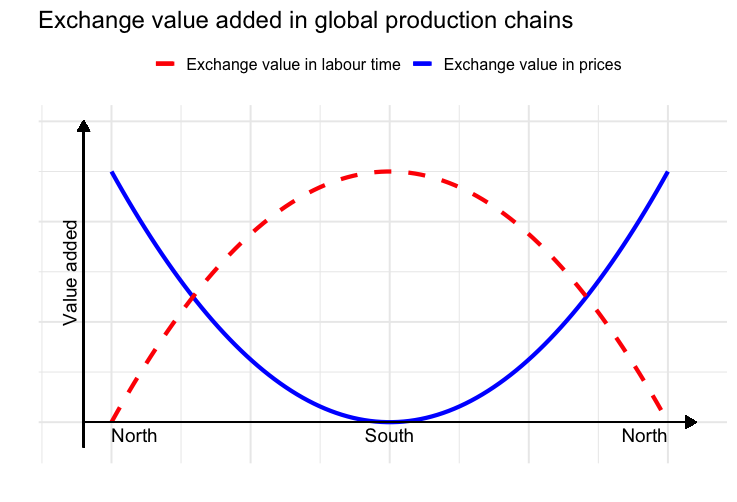
The new international division of labor not only takes the form of global production chains, but also as global value chains. In these global value chains, we meet again, the double form of measurement of the exchange-value, unfolded at the global level. On the one hand, we have the formation of global market prices. On the other hand, the exchange-value of the commodity measured in the socially necessary labor time it takes to produce it. The latter can be quantified as the price of labor—the hourly wage. In this increasingly globalized capitalism, we have a situation where the prices of commodities tend to be globalized, except for one commodity—that of labor-power, which differs by a factor approximately 1:10 between the Global South and North.
We can visualize the difference between the two forms exchange-value. One, a ‘happy’ smiley curve shows the value added along a production chain, generating the market price of a commodity. Another, a ‘sour-faced’ smiley curve shows the value added, at each step in the production chain, in terms of the globalized value of labor-power.
In neoliberal economic theory, the formation of the market price, for example, of a computer, is described as a production chain in which each step adds “value” to the product. The process is financed, managed and controlled by brand-holding companies mainly located in the global North. In the first steps of the process research and development and design are handled in the global North. Here wages and cost are high, hence much “value” is added, and the curve starts at the high end. Then the chain of production moves to the South, where low-wage labor produces the components of the product and assembles the product; hence little “value” is added, and the curve falls. Finally, when the product returns to the North and requires branding and marketing to be sold, there is again much “value added.” In neoliberal economic theory, lower wages mean less “value added.” Therefore the “value added” curve in a global production chain running from North to South and back again has the shape of a ‘happy’ smiley.13
However, it is not a curve of “value added” in Marxist terms but a curve illustrating the formation of the market price It does not visualize the value measured in the social necessary time it takes to produce the product. If we apply Marx’s conception of value, the curve looks different. If you draw a curve for value added during the production of a computer or a pair of sneakers following Marx’s theory, it will look like a ‘sour-faced’ smiley, the exact opposite of the curve drawn by neoliberal economists. This does not mean that the “happy Smiley” curve is “wrong.” It simply illustrates the creation of price, while the ‘sour-faced’ smiley illustrates the creation of value in terms of labor time. The reason for labor in the Global South being much cheaper than labor in the Global North is not that labor in the South creates less value. The reason is that laborers in the South are more oppressed and exploited.
During neoliberal globalization the transfer of value by unequal exchange grew to new heights. A recent study by Jason Hickel, Morena Hanbury Lemos, and Felix Barbour have quantified the size of unequal exchange:
We find that, in 2021, the economies of the global North net-appropriated 826 billion hours of embodied labour from the global South, across all skill levels and sectors. The wage value of this net-appropriated labour was equivalent to €16.9 trillion in Northern prices, accounting for skill level. This appropriation roughly doubles the labour that is available for Northern consumption but drains the South of productive capacity that could be used instead for local human needs and development. Unequal exchange is understood to be driven in part by systematic wage inequalities. We find Southern wages are 87–95% lower than Northern wages for work of equal skill. While Southern workers contribute 90% of the labour that powers the world economy, they receive only 21% of global income.14
Taking historical accumulation into consideration, the size of these figures is adequate to explain the division in the world between rich and poor countries.
However, as in the case of neocolonialism, neither did neoliberal globalization solve the contradictions of the capitalist mode of production either. It was a form in which the capitalist mode of production could develop for a certain period of time, however again creating a new pattern of contradictions.
The National State Makes a Comeback
Neoliberalism gave capitalism thirty golden years with high profit for capital and cheap products for the consumers in the global North. However, contradictions develop, and their aspects are in constant struggle. In short, it was unavoidable that neoliberalism would encounter resistance.
As neoliberal globalization developed, the negative consequences became more and more visible both in the Global South and North. The outsourcing of industry means the loss of jobs and stagnation in wages. Privatization eroded the capitalist welfare state. Global inequality and imperialist wars in the Middle East led to millions of refugees, who, in the global North, were seen as competitors for both wages and social services, not least by the social groups that had been most affected by the erosion of the welfare system. For a large section of the population in the Global North the pressure on wages, the erosion of the welfare state, and the “migration problem” provoked nostalgia for the strong nation-state as a bulwark against globalization’s damaging forces.
Right-wing nationalist populism became the political trend to gain by the resistance to the consequences of neoliberal globalization in the North: Le Pen in France, Alternative für Deutschland in Germany, Brexit in the U.K., and to a certain extent Trump in the U.S.
In the global South the “structural adjustments” demanded by neoliberalism was also met by opposition, often in the form of left-wing populism. The financial crisis in 2008 further strengthened the demand for state control of capital, in both North and South. The balance in the principal contradiction began to tip towards nationalism and the comeback of the nation-state.
However, one specific national project challenged neoliberal globalization and US hegemony more than others did. On one hand, the result of neoliberal globalization was an increased transfer of value to the North. On the other hand, the immense development of the productive forces in the global South began to turn the table. In their eagerness to maximize profit by outsourcing industrial production to low wage countries, transnational capital industrialized the global South, transferring technology and knowledge, which has changed the economic balance in the world-system. The rise of China as the world’s leading industrial power has broken the polarizing dynamic between center and periphery, for the first time in two hundred years.
From 1979 to 2018 the average annual rate of China’s economic growth was 9.5%, described by the World Bank as “the fastest sustained expansion by a major economy in history.” 15 The Chinese became the world’s leading industrial producer. The financial crisis was a wake-up call to the Chinese leadership to realize that neoliberalism was no longer a dynamic force to develop the productive forces, but increasingly a problem in the form of economic stagnation, social inequality, and environmental problems. The heyday of neoliberal global capitalism was over. China moved from, “some get rich first” — to “common prosperity” and getting rid of poverty in rural areas, and from relying on export to the global North, to South-South trade and expanding the home market. Wages in China have increased from around $1 per hour in 2005 to more than $8 per hour. This meant increasing discordance between China’s national project of development and global capitalism. Higher wages mean less profits of Western firms that operate in China and is reducing its exposure to unequal exchange.
China’s encounter with neoliberalism, was very different from Russia’s, the rest of Asia, Africa or Latin America. In the latter “structural adjustments” forced them to open their economies for exploitation by transnational companies, China kept its national project: “Socialism with Chinese characteristics” intact. Deng Xiaoping’s Kung-fu strategy towards neoliberalism was to bend to the pressure from the capitalist offensive without breaking the power of the Communist Party. Then use the dynamic power of neoliberalism against itself, by allowing it to develop China’s productive forces. Politics were in command of economics all the time. China had the organizational, social, and political capability to use the transfer of advanced technology to develop the prerequisites for moving towards socialism. By the rise of China, and the development of a multipolar world-system, the world is undergoing a profound change.
In the 1970s the Third World demanded another world order, today they are building it. In the 1970s the ruling class was able to launch a potent counter offensive in terms of neoliberal globalization. Today the ruling class is bewildered, they cannot rule in the old manner anymore. The U.S. is still a dangerous hegemon in the military sense, but the global South is on the offensive on the economic front. While the transformative power of the Third World in the 1970s was based on the “revolutionary spirit”- the attempted ideological dominance over economic development – the current transformative power of the global South is based on its economic strength.
Geopolitical imperialism
With the crises of neoliberal globalization, the decline of U.S. hegemony, the rise of China, and the development of a multipolar world system, we are reaching the point where the capitalist mode of production is no longer the most effective mode of production to develop the productive forces, but has become irrational, destroying human life and planet earth.
At the same time, the transitional mode of production, developed in the shadow of dominant capitalism, has proved to be more effective in development of the productive forces. Investment in the state-owned sector is again on the rise, and strategic coordinated state planning has according to the “The Australian Strategic Policy Institute” made China the leading capacity in 57 of 64 critical technologies spanning from defense, space, energy, the environment, artificial intelligence, biotechnology, robotics, cyber, computing, advanced materials and key quantum technology areas in 2019–2023.16 The U.S. can no longer compete with China, which is becoming the leading innovative economic power in the world.
The global trade pattern is under transformation. After a hundred years, North-South trade is declining, and South-South trade is on the rise. This is manifested by the development of transport and infrastructure projects in the global South, facilitating this new trade pattern. The global value transfer of unequal exchange from South to North has begun to decline for the first time in the past 150 years. The transformation in trade structure is accompanied by changes in finance and banking in the world-system. Alternatives to the Bretton Woods institutions — the World bank and IMF are being developed in the context of BRICS+. This gives the Global South possibilities to invest and trade in their own currency instead of dollars and lend money without demands of structural adjustments and other political conditions. The states in the global South are gaining economic space and thereby possibilities to adopt an anti-imperialist standpoint.
Losing its economic superiority the U.S. has turned to political pressure and military means, in a geopolitical struggle for dominance. The US is strengthening old and making new military alliances, seeking to translate its military power into renewed economic dominance. The U.S. is dragging Europe — and so Sweden – into a confrontation with Russia, China, and the Global South in general. NATO membership is not an a la carte dish; Europe must swallow the whole American menu, including U.S. policy in the Middle East and the Far East.
Trump’s MAGA-strategy
As the U.S. no longer can maintain its hegemony by economic superiority, it also uses its domination of the global finance and banking institutions in this confrontation. Instead of the former neoliberal competition, economics are weaponized by trade wars, sanctions and blockades.
Trump tries to use the position of U.S., as the world’s largest consumer market, as a mechanism to squeeze tributes out of the rest of the world, in the form of tariffs to enter the U.S. market. The tariff-squeeze is backed up by different kinds of political and military threats.
The U.S has had a deficit in its trade balance and in its state budget, since the beginning of the 1970s. Both have now reached astronomical heights. Both deficits are an expression of the decline of U.S as a productive nation, turning it into a parasite consumer nation based on financialization.
The reason why the U.S. have been able to do this, is its control of the global financial system. After the Second World War, the U.S. managed, through the Bretton Woods institution, to turn the dollar into the world’s trading currency. International trade, for example the trade of oil, is settled in dollars, even if the U.S is not involved in a specific trade. That is the reason why all the world’s national banks need to have reserves in dollars. Since the beginning of 1970s the U.S have been printing dollars, without backing in production or equivalent gold reserves, to finance its trade and state deficit.
Due to the U.S. weaponization of financial institutions, the global South are now seeking de-dollarization. This have been met, with threat from Trump of punishment tariffs on any state pursuing de-dollarization. The problem for the U.S. is, that it is easier for the global South to live without the U.S. consumers, than for the U.S. consumers to live without the exploitation of the low-wage labor in the global South. Trump’s tariffs, economic sanctions and blockades contribute to erosion of that neoliberal world market, that for half a century have been the goose laying the golden eggs. This is a huge problem for countries like Sweden, which is dependent on an open global market.
Trump’s policies — however strange they may seem – respond to the real problem, that the U.S. do not have the economic superiority to uphold its hegemony. Trump’s demand that the E.U contribute to pay for the U.S. military apparatus, is an example of this problem. Trump’s wish to annex Greenland, Canada and the Panama Canal also has its own logic in securing U.S. rule over its three neighboring oceans, thereby consolidating its position in the confrontation with China and Russia.
The European Union — and so Sweden – has chosen to back up U.S. hegemony, in the hope, that the NATO alliance will be able to uphold the West’s privileged position in the world system. Today the Scandinavian social democracies and even the parliamentary left wing are repeating the mistakes of the socialists of the Second International in 1914, voting for armaments, leading into a world war. By supporting NATO, they identify themselves with the interest of imperialist national states.
Due to the instability of the world system, it is difficult to predict the future, even in the short run. However, one thing is certain the crises of the capitalist mode of production will be deepened, economically, politically and ecologically.
We are living in dramatic and dangerous times. We cannot rule out major wars. In worst case nuclear war. We cannot rule out climate collapse by the end of the century if we do not manage to change the mode of production. The coming decades will be decisive, not only in the struggle against capitalism and imperialism — but for the fate of humanity and planet earth.
As the late Immanuel Wallerstein, I believe the 21-century is the endgame of capitalism. Leaving his final reflection before he died in 2019, he wrote: “I think there is a 50-50 chance that we’ll make it to transformatory change, but only 50-50”.17 But the outcome, it is not a question of flipping a coin, it depends on humans — us. The structural crisis of capitalism entails that the system is out of balance and that conjunctions do not come in regular waves, but by sudden uncontrollable and deep swings. These are circumstances in which, the agent — the subjective forces of revolution can make a difference.
Conclusion
The fundamental contradiction within capitalism between the imperative to expand production versus lack of consumption power found a historical form in which it could move ahead, by the value-transfer from periphery to the imperial core. Imperialism prolonged the lifespan of capitalism for two centuries. However, imperialism was not the final solution for the contradiction in capitalism, it generated a sequence of principal contradictions.
We have seen how the management of imperialism has shifted from colonialism to U.S.-led neocolonialism, neoliberal globalization, and into the current geopolitical struggle. These transformations have been driven by the changing principal contradictions: inter-imperialist rivalry, U.S-led imperialism versus the Third World, transnational capital versus the national state and the current decline of U.S. hegemony versus the rise of China and multipolar world order.
Imperialism is in crisis, the value transfer declines, and the hegemonic power cannot rule in the old way anymore, it heralds the end of capitalism.
Lenin defined imperialism as the highest stage of capitalism, that means that the end of imperialism also implies the downfall of capitalism.
Torkil Lauesen, August 2025.
References
1 Lauesen, T. (2020) The Principal Contradiction. Montreal, QC: Kersplebedeb.
2 Emmanuel, Arghiri (1972) Unequal Exchange — a study of the Imperialism of Trade. Monthly Review Press 1972. New York.
3 Lenin, V.I. (1917) Imperialism, the Highest Stage of Capitalism. In: Lenin (1971), Collected Works, Volume 22. Moscow: Progress Publishers, 1972 page 284. marxists.org
4 Lauesen, Torkil (2018) The Global Perspective, page 60-67. Kersplebedeb, Montreal 2018.
5 Marx, Karl (1867) Capital, Vol. One, Part I: Commodities and Money, Chapter One: Commodities, Section 3 – The Form of Value or Exchange-Value, B. Total or Expanded Form of Value, 1. The Expanded Relative Form of Value. Moscow: Progress Publishers, 1962.
6 Marx, Karl (1861) Economic Manuscripts, 1861–63, Theories of Surplus Value. In: Karl Marx & Frederick Engels: Collected Works, Volume 32. Moscow: Progress Publishers (1975), p. 80
7 Marx, Karl (1861) Economic Manuscripts, 1861–63, Theories of Surplus Value. In: Karl Marx & Frederick Engels: Collected Works, Volume 32. Moscow: Progress Publishers (1975), p. 101
8 Lauesen, Torkil (2024) The Long Transition to Socialism and the End of Capitalism. Iskra books 2024.
9 Kneller, Richard, Bernhofen, Daniel and El- Sahli, Zouheir (2016). Estimating the effects of the container revolution on world trade. Journal of International Economics, 2016, vol. 98, pp. 36-50.
10 UNCTAD (2009). Handbook of Statistics, 1980–2009. New York & Geneva: United Nations. Available at: https://unctad.org/system/files/official-document/tdstat45_en.pdf (unctad.org)
11 ILO, (2011). World of Work Report 2011. Geneva: International Labour Organization, 2011. Available at: wcms_166021.pdf (ilo.org)
12 Suwandi, Intan and Foster, John Bellamy (2016). Multinational Corporations and the Globalization of Monopoly Capital. Monthly Review, vol. 68, no. 3, July-August 2016.
13 Dedrick, J., Kraemer K. L., & Tsai T. (1999). ACER: An IT company learning to use information technology to compete. P.156. Center for Research on Information Technology and Organization, University of California. pcic.merage.uci.edu
14 Hickel, Jason Hanbury Lemos, Morena and Barbour, Felix (2024) Unequal Exchange of Labour in the World Economy,” Nature Communications 15 (July 2024): 6298.
16 https://www.aspi.org.au/report/aspis-two-decade-critical-technology-tracker/
17 Wallerstein, Immanuel (2019) This is the end; this is the beginning – Immanuel Wallerstein