 By
By One of the most significant achievements of Hugo Chávez and the Bolivarian Revolution has been the incorporation of millions of working-class people into forms of participatory politics that had never participated before. First, through constituent assemblies that brought the popular classes from all over the country together to discuss and design a new constitution that would be at the service of the people, and then later through Bolivarian circles, urban land committees, and ultimately the communal movement.
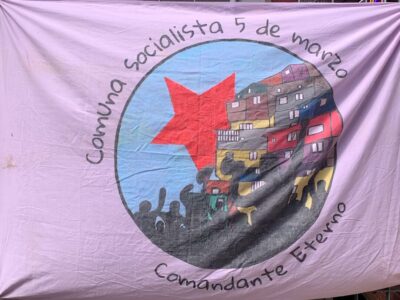
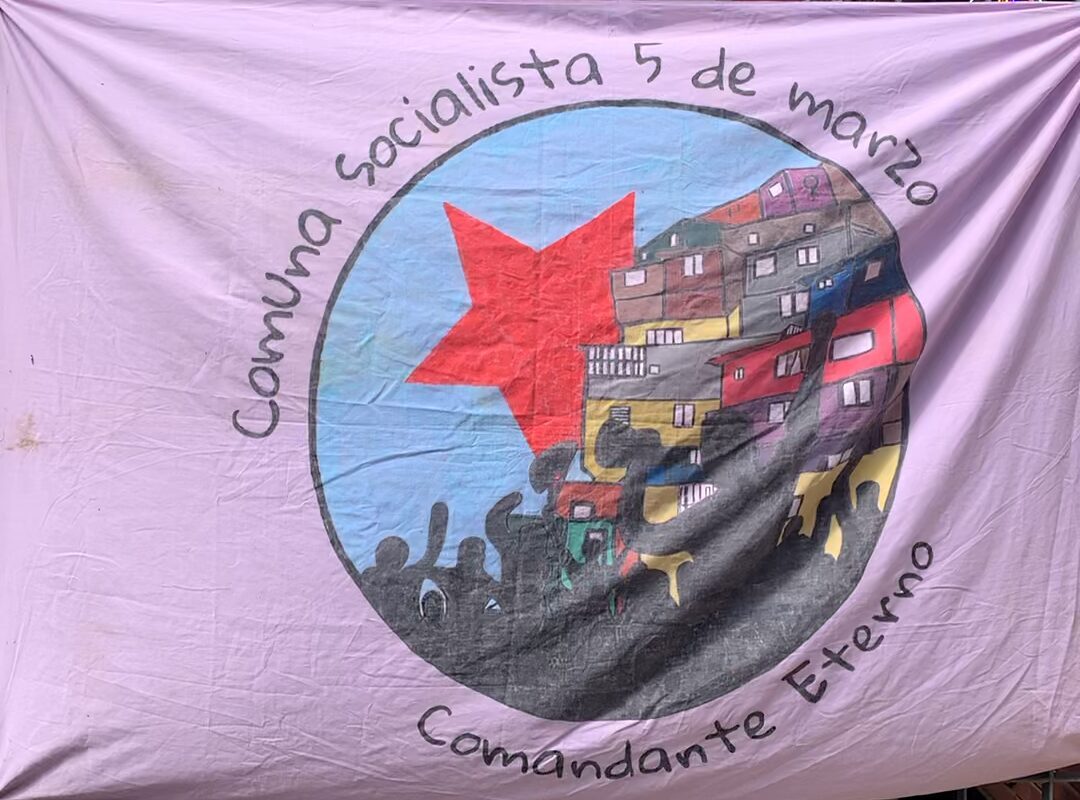
In the text that follows, Andy Hernández of the Unión Comunera and the Comuna 5 de Marzo reflects on the historical construction of participatory democracy in Venezuela.
Interview conducted by Isa Villalón.
The most incipient process of the communes were the neighborhood associations, which were, in reality, just representative. They had no power. But these neighborhood associations started before Chávez, around 1960. Through the neighborhood associations, they started a regularization process. And that regularization process, at least in Caracas—I believe in other regions of the country it was started by Clemente Escoto, who was one of the first mayors to promote the whole issue of participation—but here in Caracas it was started by Aristóbulo Istúriz. He began the whole issue of mapping the barrios1. Before, the barrios didn’t exist on the city’s map. I mean, it was a blank space and no one knew what was there: if there were people, dogs, cats… if there were houses, it didn’t matter. And, in a way, the main policy was demolition, to contain the city’s expansion, so to speak. The public policy was the demolition of the barrios and not their attention.
Later, there was a policy of barrio consolidation, which was the Fundabarrios Ministry. This allowed the barrios to have, in a way, minimal funding—this was before Chávez—but it was still very representative. Aristóbulo initiated this participation process, working to get people in sync with one another to be able to define on a map the place where they live, to be able to have an address… well, a physical address, even a postal address, because people didn’t have a postal address. I mean, they were irregular settlements, right?
After that is when things start to… we’re talking about ’94—Chávez carried out the coup attempt in ’92, February 4th, ’92—but in ’94 Aristóbulo wins, he becomes the mayor.
And then, Chávez initiated the process [of implementing participatory democracy]. The first thing he did is he carried out the constituent process to change the definition of democracy, which at that time was representative, and move towards a process of increasingly involving people in participatory and protagonistic democracy, which is the most important thing. It’s not just about participating, it’s about you becoming the protagonist of change on your street, in your state, in the country.
So, we moved from a representative democracy that, with the Constituent Assembly, became participatory and protagonistic democracy. We’re talking about ’99, and this was Chávez’s proposal with which he reached the presidency. Now, back to the political participation proposal: the first thing was the Bolivarian Circles he implemented to discuss all of this, to discuss the constituent proposal2.
After that, the first thing is, well, in 2001 the first Law of Local Public Planification Councils (Ley De Los Consejos Locales de Planificación Pública y Popular) was created, so that people could participate in public policy, both in the design, the execution, and the oversight. But there was no instance for participation, because what existed were the neighborhood associations, which were simply representative.
So, what happens with this local council of public planning? It demands that participation exists. Different committees began to appear: the land committees, the health committees, the technical water committees, the technical energy and gas committees, the technical collection, sanitation, and waste committees, etc. And, in this way, various forms or structures of participation began to exist before the communal councils existed, in order to participate in the public policy they were making at that time, which were the local councils that were anchored to the municipality.
And after that, the coup happened, and the missions were created. The missions also allowed for a broadening of participation even more. But, after that, Chávez, in 2005—with deep knowledge, but also reading everything that Marta Harnecker was doing, systematizing what was happening in Brazil, systematizing especially the issue of councils, of political participation councils, of councils where citizens would meet to define public policy—begins to talk about the communal councils.
In 2006, the first special Law of Communal Councils (consejos comunales) was born, which brought together all the existing participatory committees—the health committee, the urban land committee that allowed for land use planning, the technical committees on energy and gas, the technical committees on water, technical committees on waste collection and sanitation, the sports committee—all of them together, they said: “Well, let’s bring them together and concentrate them into a kind of council where we can define the administrative aspects and where we have a supervisory role. But not in terms of resources, rather so that this process can be set in motion.”
And that’s how the communal councils were born. In 2006, the first special law is born, which wasn’t organic, the special law of Communal Councils. That law of the Communal Councils achieves the implementation of the project, but what happens? Since Chávez comes with the vision of the local councils of public and popular planning, the communal councils were still anchored to the mayor’s office. So, the mayors defined the process, more or less. “Oh, well, this communal council can be like this, this communal council can be like that.” So, it was a very supervised process still from above, from the very structure.
But Chávez begins to talk about the need for the transformation of the State3, and from there, what is called the second constituent process is launched, what he calls the Red Constituent. That vote didn’t win, it must be said. But from the Red Constituent, which is the constitutional reform, what Chávez says is that we must transcend the mayoralties. “The mayoralties cannot be the ones that order the territories for me,” he says. “The people themselves have to order their territory, the people themselves have to design their public policy, and the diverse people have to attend to the diverse problems of society.” And that first law is then launched, which allows that to be done.
Then there was another reflection that I think is one of the most brilliant, which is from 2009, when Chávez begins to talk about theory, about popular organization, which was a theoretical milestone. In that process, when Chávez begins to speak about the theoretical popular organization of the Republic, that’s when he begins to draw from Mao, from Marta Harnecker, from the Russian Revolution, from the industrial belts of Chile, from Gramsci’s factory councils… he begins to drink from all these elements.
Of course, he begins to read a lot of Mariátegui4 and makes a reflection that for me is extremely key and important. He says: “The communal councils cannot be an appendix of the mayoralties. They cannot be an appendix of the ministries. They cannot be an appendix, not even of the presidency. Let’s not kill the child before it is born.” Precisely what he’s doing there, what I would say, is the first Strike at the Helm5 (“Golpe de Timón”). That is, he states that we cannot expect the transformation of the State to be guided by the State itself. It has to be guided by the people. This has to be a permanent constituent process. That is, in essence, what the commune and the communal council are: a permanent constituent process. If it is a permanent constituent, it means that truth and sovereignty reside in the people, in the population, in the one who is there writing it. So, for me, that contains many things. But what it contains most is that this process belongs to us.
So, from there, a reform of the laws begins and others are incorporated. What is called the battery of laws of popular power (batería de leyes del poder popular) is born. Now the law of communal councils… it’s no longer just about communal councils. Chávez talks about how the communal councils cannot be isolated entities, that only serve to submit projects.
All that Chávez is saying is precious, because it is a process of systematization of what happened from 2005 to 2009, and he is talking about that process of systematization, of critique, because the good thing about all of this is that it was a creative process. So, that process, which is Chávez providing a synthesis of everything that has occurred, with the political acumen to see what is happening and with the projection of what could happen.
What does Chávez do? He says: “Well, the communal councils cannot be anchored only to their territory.” And he says: “There has to be a kind of network, a modification has to be made there.” And he tells the minister of that time: “For there to be a federation of communal councils, they cannot just be thinking about their territory.” And he says this phrase: “The local, confined to the local, is counter-revolutionary.”
Beautiful, beautiful, because then, what happens? He says that you have responsibility for what happens in your territory, but also outside your territory, because we are not disconnected. I mean, I am as responsible for what happens in Venezuela as for what happens in Latin Americ; one is responsible for what happens in Venezuela and Latin America, as for what happens in the world. That is, we are building a model, and that is where Chávez gives it the universal vision, which I believe, for me, is the genius: we are building a reference. We are not saying they should do what we did. Not at all, but we are building a reference of what people can do, of what the people governing can do. So, I believe that element of that systematization says many things. There are many videos that capture it, our comrades from TatuyTV—which is a foundation that collected many videos of Chávez.
So, the set of new orientations in the laws comes out: the Organic Law of Communes comes out, the Organic Law of Communal Councils, the Organic Law of the Communal Economic System (which did not exist before), the Organic Law of Public and Popular Planning, the Organic Law of Management of Transfers and Other Attributions to Popular Power and, afterwards, another set of laws, but those are the most important.
So, what does that allow? That there is no longer a single, unequivocal way to organize the territory. There is a general orientation, yes: communal councils, but the people decide how they are going to do it. The other thing these laws do is, well, there is now an integration, there is a unified national system. That is, it is no longer a small project that belongs to your communal council, that belongs to your solitary, isolated village, but now there is a fabric—and I really like that word, because Chávez uses biopolitics a lot to explain it.
We are like a cell that branches out to create the organ, but the organ is not the organ if it is not clear and fulfills the function of a body. But a body is not a body if it is not a body integrated by the economic, the political, the social, the psychological. So, an understanding begins to take shape that the commune is not destined to be small, but to be thought of as a national body.
There was even a speech and a phrase back then from the Ministry of Communes, which I loved and which struck me deeply, which is: “the commune is the new homeland.” And the homeland is the entire national territory. So, that element began to link up. Then the communes began to emerge, and, after the communes what? Ah, well, after the commune can come the communal city. But, after the communal city, what? After the communal city can come the Communal Federation. But after the Communal Federation, what? Well, the Communal Action Confederation, which is the new national fabric, the new body of the nation. The idea is that we culminate the refounding of the State when all public policy is confederated in a set of communes aggregated in a staggered manner, so to speak, or in a scalar way.
In this way, you cover the entire national body. We haven’t reached that point yet—this is the horizon, what we call in our course the ‘communal horizon.’ That element is what ultimately provides, so to speak, the formula for the national level. That’s where we are at the national scale. But Chávez—and Fidel as well, because it wasn’t only Chávez, Fidel was part of this too—when they defeated the FTAA [Free Trade Area of the Americas], they proposed a regional alternative, which was ALBA [Bolivarian Alliance for the Peoples of Our America]. And ALBA is nothing more than the exchange and deepening of the regional economy. Those within ALBA—the idea was that all of Latin America could join—participated in a system of solidarity-based economic exchange.
We contributed petroleum and, for example, Guyana would send us rice, others would send us sugar. It was a system of solidarity exchange between nations. So you can see how the whole process is scalable or, like, interlocking. So, notice that it’s all there: the economic dimension, the political dimension, the territorial-organizational dimension, but the subjective dimension was still missing.
And so, in the last “Strike at the Helm” (“Golpe de Timón”), Chávez says: “But the thing is, the commune, then, as it stands, is just a paper. And I see everything looking very pretty on paper and all that, but where is the commune? And more important than the commune itself, where is the spirit of the commune?”
That the spirit of the commune, precisely, is that every man or woman, from whatever position they are in, has the opportunity, the intention, and the vocation to promote and motivate the participation, and above all the protagonism, of the organized people. Organized in what? In communes. And it’s at that point that he scolds all the ministries: ‘I’m going to have to eliminate the Ministry of Communes,’ he says. ‘Everyone talks about communes and thinks the ministry is the one that has to take care of everything.’ But the commune itself is Venezuela’s development model for achieving supreme happiness, according to Chávez and the socialist project. So, that’s where he ties the whole exercise together.
We went from 2003, 2006, 2007, 2009, 2010, 2014… If we get to the latest reforms made in 2023, in 2024, we would be saying that now we are walking, taking a few steps further, allocating part of the resources to all territories organized as communes. And that is the stage where we are right now. We haven’t arrived yet—that must be said, this is an ongoing process, a permanent constituent process, a constituent process of the people. Difficult, yes, but capitalism is destroying humanity, so it falls to us to take on what is difficult.
Footnotes:
- Barrio is an urban neighborhood where mostly popular classes reside.
- Although not formally part of the 1999 Constituent Assembly process, the Círculos Bolivarianos were grassroots political organizations that combined political debate, civic participation, and local problem-solving to help consolidate the constituent project by turning constitutional principles into everyday political practice.
- Chávez repeatedly emphasized that the bourgeois state could not make the Bolivarian Revolution, and that the communal movement was the vehicle for transforming the inherited capitalist state into a new “communal state. Chávez ultimately believed the Bolivarian process required a dual power strategy, in which new institutions were built from below until they could become the dominant form of governance.
- Although José Carlos Mariátegui (1894-1930) did not strictly theorize about such an experience as the comunas within themselves, he is commonly referenced by Hugo Chávez and other Bolivarian thinkers first, for his rejection of imported versions of socialism, famously stating, “We do not wish to copy or imitate, but to create.” In other words, he insisted Latin American socialism must emerge from local realities, not as simply a copy of European models. Mariátegui also rejected determinist Marxism and emphasized that socialism cannot be decreed or administratively installed by the state, but must be collectively produced through struggles and new forms of popular power. This idea that was central to Chávez’s Golpe de Timón, where he urged that communal institutions remain autonomous from state bureaucracies.
- “Golpe de Timón” is the term Hugo Chávez used during his final televised cabinet meeting in October 2012 to call for a decisive course correction within the Bolivarian process. In that speech, he criticized bureaucratic inertia and insisted that the revolution’s future lay in deepening popular power, specifically through communal councils and communes as engines of a permanent constituent process. The phrase has since come to serve as shorthand for Chávez’s call to overcome bureaucracy and place political sovereignty in the hands of the people.