
 By
By Torkil Lauesen held a presentation in Amsterdam (23.6.2025.) about the state the anti-imperialist movement is in. We are reproducing the transcript.
Intro
I have been asked to present some reflections on the struggle against imperialism, in our part of the world – the centre of imperialism – in the 1970s, and today.
I these dramatic and dangerous times, it is a bit strange, to ask you to listen to an old man, talking about his experience in a tiny organization, with a limited praxis in Copenhagen fifty years ago.
For sure I do not want to give the impression that we were important in any way. It is the story about how historical events, had an impact on the micro level, on small groups of people.
But, on the other hand, I think it is important to compare experience and exchange knowledge between different historical periods, places and organizations, in this case between the 70s and today, where a new generation of anti-imperialist have emerged in connection with the struggle in Palestine. Continuity in the struggle matters!
History is not only the foundation on which the present is built. The strategies we develop to change the world are based on our evaluation of past struggles. In this way, the past stretches into the future.
The situation of the struggle can change rapidly. We see changes in the world system, not seen in the past hundred years. We might encounter a more authoritarian period, where an anti-imperialist position, will be considered national treason, and hence criminalized.
Before moving into strategy and praxis of anti-imperialist struggle in the 70s. I need to give a short analysis, of what we – and I – mean with the concept of imperialism and present the historical framework of our anti-imperialist struggle in the 1970s.
It is important because we then – and I now – emphasise the link between analysis, strategy, and praxis. So here is my condensed analysis.
Imperialism is essential for capitalism
Imperialism – in the context of capitalism – is the transfer of value across the world-system, from periphery to the centre.
The genesis of capitalism, and the creation of the modern world-system by colonialism, was a simulations process, beginning in the Italian city states in the 15th century, over Spain, Portugal, and the Duch empire, ending with the breakthrough of industrial capitalism in England in the beginning of the 19th century.
The value transfer, in the form of gold and silver and other colonial goods plundered or produces by slaves and low wage workers in the colonial periphery, united and polarized the world-system into a center-periphery structure, characterized by super-exploitation of the labor force in the periphery, and rising wage, in the center. This expanded consumption power solved the inherent contradiction in the capitalist mode of production between the need to expand production, and the lack of purchasing power to consume production, in the center.
The consequence was a dynamic development of the productive forces in the center, and at the same time blocked development in the periphery. Imperialism became the necessary driver of the overall capitalist development in capitalism. So, imperialism is not just a feature in capitalism; it is essential for its function.
That is why anti-imperialist struggle is important!
The political consequences
The political result of the economic polarization of the world-system in rich and poor countries – in over- and under-development, was the establishment of a relative political stable centre, in which capitalism was not challenged from within. The last major revolutionary attempt was the German revolution 1918-20. There was no “need” so to speak, and hence no successful revolutions in the center; capitalism was dynamic and vital.
The revolutionary momentum moved to the periphery of the system. Here capitalism eroded feudal and other pre-capitalist modes of production, but the development of the productive forces was blocked by super-exploitation, and the flow of value towards the center.
The economic conditions, and blocked development created constant crises and recurring revolutionary attempts. Only a revolutionary process could get the wheels of the economy running again, by initiating the development of some kind of a “transitional mode of production”, on the long road towards socialism.
I use the term “transitional mode of production run by a transitional state” instead of “real or actual existing socialism”
It had to be “transitional mode”, because the overall world-system was dominated by capitalism economically, political and military. The lack of development of productive forces in the periphery, and the hostile world-system hindered a transition to a more advanced socialist modernity. This is the history of Soviet and Chinese revolution, and other Third World attempts to develop socialism in 20th century.
The capitalist mode of production rules the world market, and the hegemonic powers, first the British, then the U.S Empire ruled the world system of states, political and military.
So, what we have seen, in the past hundred years, is not a competition between a socialist mode of production and capitalism. It is a dominant capitalist world system interacting with an opposition in the form of transitional states and revolutionary movements in the periphery.
Marx expresses a general rule of historical materialism in the preface to: The Critique of Political Economy:
“No social order is ever destroyed before all the productive forces for which it is sufficient have been developed, and new superior relations of production never replace older ones before the material conditions for their existence have matured within the framework of the old society.” [1]
Why so? As long as the capitalist mode of production is dynamic, generating profit, expanding accumulation, it will strengthen the power of the ruling class and the hegemonic state in the world-system. However, when the mode of production becomes dysfunctional, when the development of the productive forces is blocked, the global system will be in crisis.
The imperialist value-transfer entailed a dynamic development of the productive forces within a world-system, in which the capitalist mode of production as a whole is dominant in technology, finance, political and military power.
The political framework
This does not mean that the capitalism was not challenged by revolutionary movements in the periphery and by socialist orientated “transitional” states.
After the Second World War two major contradiction shaped the political development in the world-system:
The first was: The bloc of transitional states versus the West led by US – the new hegemonic power.
The Soviet Union came empowered out of the war. This in combination with the Yugoslav, Albanian revolution and the establishment of people’s republics in eastern Europe was the one aspect in the contradiction.
Expression of the contradiction were: The division of Germany and Berlin, and confrontation in Eastern Europe in general.
The establishment of the people’s Republic of Korea, and China in 1949, and the Korean War in 1950-53, involving a military confrontation between the U.S. and China. The Cold War, and the arms race, the Cuban crises and so on.
The second was: The decolonisation and national liberation struggle in the Thirds world versus US neocolonialism.
The inter-imperialist rivalry, the change from colonialism to neocolonialism in transformation from the British Empire to U.S Hegemony. and the balancing role of the transitional states versus the West – all this opened of a window of opportunity for national liberation in the Third World.
Beginning with the decolonization of India and the revolution in China, a wave rolled over the Third world in the next three decades from Vietnam in the East over to Algeria and Cuba in the West. The national liberation struggle was often led by communists.
If you put pins on a world map marking revolutionary struggles in the late sixties, it seems like world revolution was in the process.
This revolutionary spirits from the Third World were also felt in our part of the world. Let´s see how these macro events – create events on the micro level.
Who were we?
The Communist Working Circle (CWC) was founded in December 1963, as a split from the Danish Communist Party, which was loyal to the Soviet Union. The split was linked to the Sino-Soviet split. The pro-Chinese fraction was inspired by the revolutionary spirit of the Cultural Revolution in China and all the revolutionary struggles in the Third World.
CWC has its roots in the Danish Communist Party (DCP), and its Leninist tradition in form of organization. The DCP had played active role in the struggle against Nazi Germany’s occupation of Denmark during the Second World War, and before that, members had participated in the Spanish civil war, and in COMINTRENs secret revolutionary and anti-fascist struggle in the 30s., so it that sense it had a history of revolutionary work.
However the Danish Communist Party, situated in the Scandinavian welfare state, in the 1950s, soon slipped into reformism focusing entirely on parliamentarism. It was this lack of revolutionary spirit in the DCP, and the compromising attitude of the mother party in the Soviet Union, after the 20th Party Congress in1956, on one side, and the inspiration from the anti-revisionist faction in China and from the national liberation struggle in Vietnam, on the other side, which made up the ideas for the formation of CWC. CWC became Europe’s first Maoist organization and maintained contact with the Communist Party of China from 1963-69.
CWC hoped that once they explained the mistakes of DCP’s revisionism, more members from DCP would join them, but it was not so. The same negative response came from left-wing trade-unions, and workers in the large Copenhagen factories and shipyards.
The revolutionary spirit from the Thirds World was not the spark which could ignite a prairie fire in our part the world. The agenda of the working class were limited to higher wages, and more welfare, within capitalism and liberal democracy.
CWC policy had more appeal to young people in the late sixties, and the protest against the Vietnam war. CWC had a strong internationalist orientation. It was the first organization in Denmark to call for a demonstration against the Vietnam War on February 8, 1965. The same year, CWC initiated a program to collect funds for North Vietnam. In 1966, CWC founded “The Vietnam Committee.” This anti-imperialist solidarity work became the main source of new young members and sympathizers for the organization. CWC sold more 25.000 copies of Mao little red book. They formed a youth organization to Communist Youth League, and a front organisation: the Anti-imperialist Action Group.
The negative response from the attempt to mobilize the workers and the emerging anti-imperialist current in the late 60s, made CWC to develop a unique profile within the European left. A series of articles under the heading “Perspectives for our Struggle” were published in the groups journal. They explained that: The working class has no chance of toppling the capitalist class and introducing socialism before the foundation of the capitalist class has been undermined by the struggle and at least partial victory of the peoples of Asia, Africa, and Latin America. Western Europe was not a “dry prairie” to be ignited by the revolutionary spark, as in the Third World, but rather a damp meadow- Denmark was a parasite state.
CWC’s economic foundation for this conclusion was, that the value transfer from colonies and dependent countries had, in part been used to turn the former “dangerous classes” in the imperialist countries into loyal citizens. For sure, the working class wanted a higher living standard, but socialism? For this, they showed no interest.
Super-exploitation of the global South and other forms of value-transfer had created the foundation of an imperial mode of living in Western Europe and North America. If we want socialism to become a reality in the Western capitalist world, including Denmark, then it is our duty to support oppressed nations and peoples in their fight against Western capitalism. The victory of the peoples of the Third World over imperialism the decisive factor which would then lead to a revolutionary situation in Europe and North America.
In that sense, it was not just a projection of the missing revolution in Denmark made by “romantic revolutionaries” onto the Third World. The main task was still to be able to pinpoint the turn of events that would create a revolutionary situation in Denmark. The strategy was to support the liberations movement in the Third World, to cut the pine lines of imperialist value transfer. And at the same time build an organization for the future struggle. here.
This analysis had also some organizational implications. Most of the old members from DCP left, as they could not accept the parasite state theory implicating that the majority of the working was a global labour aristocracy. The leadership of CWC were wondering if it was possible at all to build a revolutionary organization in a country, where the social circumstances were not ripe for radical change, and the wish for socialism in the working-class diminutive.
The anti-imperialist struggle was not integrated in social structure of our society. It was something you could choose out of interest – and you could move out of, when it does not suit the interest or personal career.
So, if it is possible – in spite of all this — what could such an organization look like? Would it be possible to mobilize members with the dedication and discipline needed for such an organization? What should their praxis be?
In the late 1960s, much of the anti-imperialist activities in Denmark focused on demonstrations against the Vietnam war.
With what purpose? To make more people aware of the atrocities? To try to change the policy of the government? To mobilize new members to different left-wing organization.
The CWC members wanted not just to protest and demonstrate, but to stop imperialism and support the anti-imperialist struggle directly.
In 1969, “The Green Berets”, a film starring John Wayne about US special forces in Vietnam, premiered in a large Copenhagen cinema. CWC did not only want to protest against the movie, but to stop it. In the screening hall, chairs were smashed, and butyric acid poured on the carpet. The movie was taken down. CWC also participated in the militant demonstrations against the World Bank meeting of 1970. The aim of CWC was not just to protest, but to stop the event. Molotov cocktails were thrown through the windows of the congress centre, but sprinklers prevented greater damage.
The organizational development of CWC became a human resources management project. Out of the crowd who were attracted by the radical profile and protest actions by Communist Youth League, and the Anti-imperialist Action Group, new members were recruited to CWC. One criterion was dedication. Members were expected to prioritize political work. But dedication was not enough; discipline was another criterion. The dedicated but “wild ones” were sorted away, even though some were eager to become members.
What was needed was an organization of more or less full-time party members, dedicated, and able to act in unity and discipline after a strategy, laid down by the leadership of the organization.
What had such an organization to offer? What was the attraction, which led me — among others—to join the group? First: the analysis. The “parasite state theory,” corresponded to my everyday experiences. It explained that there was a direct connection between the wealth in our part of the world and the poverty elsewhere — imperialism. The parasite state theory also explained why the working classes in our part of the world were not interested in socialism, but only in changes within the system, that would grant them a bigger share of the cake. The analysis was followed up by clear strategy—support the liberation struggle in the Third World, to cut the pipelines of imperialist value transfers.
Second: From the first time, I meet members of the group, I could feel the dedication. It was not only the logic in CWCs the theory that appealed to me; it was also the commitment and integrity of the members – it was not only talk.
After years as an active sympathizer, I became a member of CWC. Long time personal knowledge was a precondition before you were let in, making it very difficult to infiltrate the group. Being a member, I felt like a little cog in a big machine fighting for a different world order. Emotions were the driving force, theory provided guidance, organization brought structure, and practice gave concrete results.
Our organization
So, CWC was not a random loose connected network of friends and comrades coming together, it was a group with a strong unity in political outlook, dedication and disciplined picked by a leadership.
This created an energy to manage several tasks. The organization had a publishing house, membership offered the opportunity to learn how to produce material from layout and reproduction, to offset printing and binding books. Schooling and theoretical development was an important component in the group. With the background of decades in the Danish Communist Party, the old comrades knew their classics. There were weekly study-groups and sometimes longer seminars. But schooling was seldom done in the form of general and abstract appropriations of Marxism. We needed methods that tied analysis and practice together.
The political economy of Marx’s Capital was used to study and explain the forms of imperialist value-transfer. The dialectic materialism was used to find the “principal contradiction”, in the world system and from this a strategy for action. State and class theory were used in order to define the characteristics of the social democratic welfare state, and class struggle in the parasite state. Historical materialism was used to explore how Scandinavia was integrated in the imperialist core.
But also, more specific limited issues were analysed: What was the position of migrant workers in Europe? What was the “hippie culture” an expression of? For a period of a year, four comrades lived and worked in Frankfurt in order not to limit our perception of European capitalism to the Scandinavia welfare states. On top of this— and most importantly—came the specific economic analysis of different Third World countries and their political movements, to decide who, and how, they could be supported. This was not only done by studying books, but also by study trips to the Third World.
To develop our strategy and to make the decision about where to concentrate our limited efforts and resources, we studied the economic and political development of a number of countries across the Global South. In addition, we travelled to Asia, Africa, and the Middle East to experience the situations first-hand and make personal contact with the liberation movements. Our travel experiences and talks with liberation movements convinced us of their revolutionary potential. By supporting the struggle there, we could contribute to a radical change of the world order.
As a result of Third World liberation movements’ victories, we expected socialist states to emerge that would put an end to the super-profits of transnational companies and the unequal exchange between the world’s rich and poor countries, and there by creating a revolutionary situation in our part of the world
In order to maximize the result of our efforts, we had to identify the regions that seemed economically and politically the most important for imperialism. We identified the Middle East as one such area. The region’s oil reserves were of vital interest. The Middle East also had geopolitical importance: it was situated along the transport routes to and from Asia, and it was close enough to the Soviet Union for the US to launch a military attack.
We also studied the different liberation movement. Is their ideology nationalist or class-based and socialist? What does their organizational structure look like? How do they relate to the masses? What are their strategies, tactics and specific practices? We needed to support the right movements in the right region.
Witnessing the living conditions in the Third World, and meeting Third World revolutionaries, strengthened our commitment. It sparked a feeling of personal responsibility: Third World liberation movements were no longer abstract political entities, but comrades to whom we felt obliged.
The Praxis
The demonstrations against the World Bank Conference in Copenhagen in 1970 made us reflect on the utility of fighting with the police in the streets of Copenhagen. At the same time, we had our trips to Jordan, Lebanon and Mozambique, which made the needs of the liberation movements specific, and we made personal contacts which made practical cooperation possible. So, the decision was made to scale down political activities to influence the political situation in Denmark and instead focus on material support to the Third World liberation movements.
In the following years it developed into two separate forms of providing material support—legal and illegal. Material support can consist of many things: money, radios, electronic equipment, tents, food, clothes and shoes, medicine, weapons and logistical assistance. But it can also consist of other forms of service: for example, studies that the liberation movements needed, but do not have the time, resources, or the data to conduct.
In1971, CWC founded an organization with a rather inconspicuous name, Tøj til Afrika (TTA) [Clothes for Africa] to provide material support. Its members were sympathizers, and other anti-imperialists, but the goal was not to push ideology. The organization collected clothes, blankets tents and shoes to be sent to refugee camps run by the liberation movements in Africa and the Middle East. We also organized flea markets and ran second-hand stores to generate cash. On weekdays and during holidays, we sorted and packed clothes by the ton. They were shipped to destinations where they could be received by the liberation movements.
TTA had chapters in Copenhagen and four other Danish towns, and during its heyday it had about one hundred members overall. In the 1970s, TTA supported FRELIMO in Mozambique, the MPLA in Angola, ZANU in Rhodesia, SWAPO in Namibia, and the PFLO in Oman. In the 1980s, it also supported a Black consciousness project in South Africa by the name of Isandlwana Revolutionary Effort (IRE).
In addition to clothes, shoes, blankets, tents and medicine, we sent the money we made from the flea markets held every month, amounting to around fifty thousand dollars per year. In the 80s we also established Café Liberation, run by activists, to generate a profit for the liberation movements. CWC had a printshop which produced the leaflets and posters for the collection of material, but also magazines, pamphlets, and posters for the liberation movements.
Beside this legal praxis we also developed an illegal undercover praxis.
Undercover
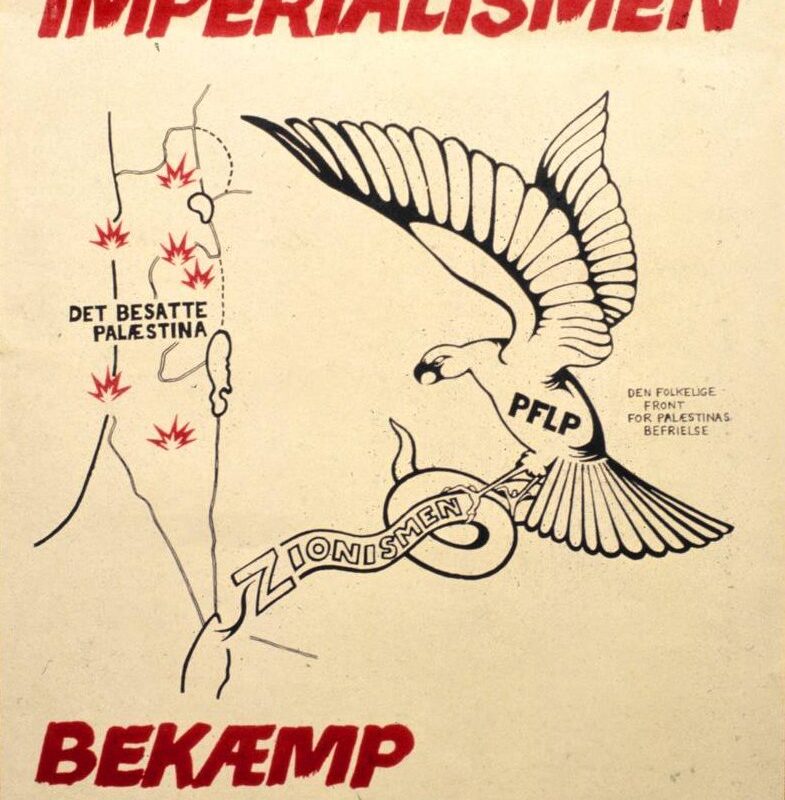
Our relationship with the Palestinian movements began in 1969, when a group from CWC went to Lebanon and Jordan. We were especially impressed by the analysis of the Popular Front for the Liberations of Palestine (PFLP). The slogan “Our enemies are imperialism, Zionism, and Arab reactionaries” spoke to us. The State of Israel is a distinct settler colonial project, but at the same time it serves the interest of U.S-imperialism. by controlling, the region, the pathway to Asia and the huge oil reserves.
This factor makes the struggle of the Palestinian people important, above and beyond the battle for National Liberation. We did not primarily support the PFLP because of it wish to establish a Palestinian nation-state, but because the PFLP envisioned a socialist Arab world. In the 70s, the PFLP had party-cells in different Middle Eastern and North African countries. PFLP had a strong internationalist outlook. It allowed liberation movements from around the world to use its facilities. It was essential for us to support organizations that did not stop at national liberation but were eager to lead the struggle further, toward economic and social liberation.
Political discussions convinced the CWC that it was important to develop its material solidarity work with the PFLP. One of the possibilities was to acquire funds in illegal ways. The illegal practice started as an experiment after long and thorough discussions by a central core of the membership. As the first illegal actions were considered successful it was decided to develop this practice.
This, however, demanded some structural changes within the organization. The creation of a small group within the organization, which should carry out this practise. The leadership asked the members, which they think were interested and had personal profile and the skills needed. Again, it was a human resource management process, not a random coming together of the “wild ones”.
For the illegal praxis it was necessary to establish a unit suitable for performing this praxis. Clandestine work needs a special form of organization to be successful.
Security was tightened internally and in relation to outside partners. We had contacts with Palestinians living in Denmark, especially the Palestinian Workers Union (PWU); however, we stopped that because of the intelligence service’s close surveillance of Palestinians living in Denmark. We would not mingle with people which we knew attracted surveillance.
We did not go directly from demonstrations and arranging flea markets to expropriating cash-in-transit trucks and execute fraud schemes. The old people in the organization, carried, the history of the Danish Communist parti and its participation in the struggle against the German occupation in the 40s. CWC had assisted a group of Indonesian communists stranded in East Europe with false passports to secure them a secret return to Indonesia in order to reestablish the Communist Party after the Suharto led massacre in 1965-66. Members had participating in the occupations of the Jordanian embassy in Copenhagen in protest of “Black September” 1970, and street fighting with the police up through the 60s. There is of course a significant step from these kinds of activities to acquiring money for liberation movements by illegal means. However, these activities functioned as a kind of bridge, providing a selection process for determining who is interested in participating in illegal activities.
You come to know bridges after you cross them – not before. You own an experience after you have lived it. You cannot learn to play a violin by watching someone do it, you have to practice. You need to use the tools, the technology, the methods, before you can master them. Clandestine work is not different from leaning to be a carpenter or a bricklayer.
The transformation from being a low abiding citizen to clandestine work, breaking conventions was a step-by-step process. In the beginning difficult and hesitant, however, with the praxis in small steps, skills grow, and the individual insecurity gets smaller and the collective project of support the liberations struggle gets stronger.
A training scheme was implemented, starting with small and simple tasks. It could be making a false driver’s license and renting a car or stealing license plates. These actions were also the first learning steps in careful planning and secret communication.
A twofold strategy
In a broader and longer perspective our illegal practice was a twofold political strategy. One purpose was to provide Third World liberation movements with material resources. The other was to familiarize CWC members with illegal work, which was deemed necessary in a future revolutionary situation.
First, liberation movements had to be supported in order to throw imperialism into a crisis, which would lead to a revolutionary situation in Europe. Second, an organized group had to be ready to seize the opportunity to broaden the struggle, when it occurred in our own country.
As we were in it for the long haul, for tactical reasons, we needed to work undercover. The illegal activities had to look like ordinary “apolitical” crime. We wrote no communiqués about expropriations and the like to explain or justify our actions. We knew that we didn’t have any support among the Danish population.
Going underground, in our part of the world, in a political climate, where the support for the system is strong, is complicated on the organizational level, and burdensome on the personal level. I take up time and resource and focus from the real target – the support to the liberation’s movements. Going underground is not a necessity to perform clandestine work; on the contrary it can complicated it.
Had our illegal practice been openly political, it would have forced us to go underground, and we would have been chased down in no time. The undercover tactic made it possible for us to operate for almost twenty years.
Clandestine work demanded certain skills. First of all, secure communications, and the ability to handle surveillance. This was important because of the frequent transitions from legal life to undercover illegal activities and meetings in “safe houses”. These techniques had to be performed in an inconspicuous way, in order not to attract further attention from the police. It was the game of avoiding surveillance, without behaving as you wanted to avoid surveillance. One mistake in this “game” and our cover would be blown, not only for the individual, but for the whole organization.
There were other skills to be learned. How to set up safe apartments to store material, for planning meetings and base for actions. The method variates, the rules and regulates are different from country to country, from city to city. Find a location, where you can be anonymous, without curious neighbours. The trick is to creates a false trustworthy identity, and to have an address to rent the apartment from in the first place. This has to be delinked and without trace to any person connected to the organization. Making false documents and identification papers, is part of the job. The skills from working at the publishing house were handy in making false documents. We used disguise techniques: uniforms, wigs, false beards, and makeup. Performing a role, is part of clandestine work. A trustworthy tenant, nice lady, businessman, postman, carpenter, police and so on. Feeling comfortable of playing a role and do it well is a skill.
Picking locks, stealing cars, sailing a boat, crossing a border —the list of skills is long. In the preface to a book about our group Klaus Viehmann, former member of the German “Second of June Movement,” called us “Craftsmen of the world revolution.”
You cannot copy paste our clandestine skills from the 70s. Such skills change from time to time and from place to place. Norms, culture, formal and informal rules are different from country to country. There is a constant development of technology, which has an impact on how to preform the skills. Cars and locks are not open only by keys but often are electronic and by codes. There are Mobile phone, GPS-trackers, video-surveillance, biometrics, artificial intelligence. The new technologies can make clandestine work more difficult, but it can also be used to advance clandestine work.
The trick is to be creative. As the late Ho Chi-Minh said in confrontation with the most advance military power, during the Vietnam war: “the human factor is decisive in the struggle”.
Up through the1970s and 80s we managed to execute a series of robberies and fraudulent activities. The success was based on careful planning. The trick was to figure out when and where cash was most concentrated, transported, and stored—and most importantly—easy to get access to. What was the best place and time to hit? Then, how to get near the target without looking suspicious and then act quickly and precisely with a minimum use of force. Here was disguise and the ability to play a role important, postman, police, carpenter, handicap person and so on Finally, we needed to have a well-planned escape route. Here knowing and analysing the structure of the city, backyards, small allies, and underground parking. Shifting means of transport and looking different and so on, was important.
As we continued the illegal praxis over the years, we tried to change modus operandi, the way things were done, so it did not look like activities done by the same organized gang, but rather a series of different “lucky punches” by different petty criminals. Steal the cars in different ways, appear different and so. This is not easy, as there is a best way to do thing.
The decision to embark and execute such a praxis should never be taken lightly. In practice, there is a real dilemma between the means and the ends. What means are just and suitable to obtain the desired ends? You inevitably encounter these dilemmas as a political militant. The answers to these questions are not general and abstract, they have to be related to the specific situation, the time and place, organizations and persons involved.
We justified our limited use of violence—in comparison the brutal imperialist war machine—with the material support that these means allowed us to provide to liberation movements.
We experienced the difficult situation of the liberation struggles firsthand in our visits. The struggle of the Palestinians was our struggle. They were our comrades. The massacre of the Palestinian Tel al-Zaatar refugee camp in 1976, and the Sabra and Shatila massacre in connection with the Israeli invasion in 1982, made a huge impression on us because we had visited these camps and talked to the people living there.
Our illegal practice ended suddenly on April 13, 1989, when six comrades, including me, were arrested. There was not one single mistake that led to the arrest, but cumulative incidents over the years, and our occasional negligence allowed the police to track us down. However, there was no hard evidence, and we were to be released within 48 hours. But shortly after our arrest, a comrade— in the process of “cleaning up” evidence — was gravely injured in an automobile accident. In his car was some in incriminating evidence, including a phone bill with the address of our safehouse. This allowed the authorities to put us on trial, effectively meaning the end of our group.
Let me sum up our experience with clandestine work
First, I want to point out that we were a small group with a limited number of operations. We had for sure no political impact on our society as we were operating under cover as ordinary crime. It was a discreet and modest service to some liberation movements, and the same time an effort to develop an organisation with the necessary skills. However, this does not mean that you cannot extract some leaning from the experience, as we manage to preform our praxis in 19 years.
The principal contradiction in world-system, and hence the form anti-imperialist struggle is different today from the 70s. We should not be nostalgic. Each experience of struggle has its own characteristics depending on the organizational framework, the level of struggle, the geography characteristics: jungle, mountains, urban environment and so on. Also do the habits and culture of the society, the technological resources of revolutionary forces and the enemy – all this change in time and space. Cool cash is not floating around in society anymore. It would be stupid to copy paste robbing money transport today.
The living soul of Marxism is the specific analysis of concrete time and place. But on the other hand, every specific experience contains something general. Clandestine work is a general phenomenon among people in revolutionary struggle – through time and space. There are some general rules and skills which unites this type of work.
Secret communication, how to avoid surveillance, but also how to carry out surveillance. Settling up a safe house or base. Creating identities, disguise, getting transportation and so on. Technology change. This influences the struggle, it enhances the ability of the intelligence, but also the capability of the resistance. There is nothing new in this. We have to take that that into account and be creative.
One advice is to take small steps, one by one, and carry out planning, planning, and planning. Have a plan a,b,c,d. If that happens, we do this, if this happens, we do that. Detailed planning, like a film manuscript. But also prepared to adjust to the evolving event.
Clandestine activities as a whole depend on preventing chance events as much possible or taken them into account.
A random dog-walker, curious neighbour, water pipe that leaks in a safe house, traffic control or accidents should not lead to catastrophe. Neutralize coincident as much as possible
Evaluation of the strategy
At this point, it might be appropriate to reflect on the question raised by CWC in the late sixties: Was it possible to build a revolutionary organization in a capitalist parasite state.
Furthermore, how about our game-plan: support the Third World revolution, to cut the pipeline of value transfer to the imperialist centre, in order to create a revolutionary situation at home. What happened?
Concerning the first question:
It was certainly not possible to build a revolutionary mass party based at the time and now for that matter. Through more than fifty years, I have seen comrades coming and going from the struggle. In our part of the world, anti-imperialist is not necessary for your existence, nor embedded in the social conditions.
However, it was possible to form and keep alive a small organization, with the necessary dedication and discipline from 1970 until 1989 and it was coincidence which led to its end. I think history has shown that such counter-currents have always existed in the imperialist centre.
Evaluation of strategy
Our game plan did not work out. The national liberation struggle did not continue into economic liberation from imperialism and the creation of socialist’ states, creating a revolutionary situation in our part of the world. Instead of a world revolution, we got a new capitalist offensive, in the form of neoliberal globalization.
Being so keen on analysing the world, why did we not anticipate this turn of event? Because our understanding of historical materialism was inadequate, and our analysis was not sufficient dialectic.
We thought that the will of the revolutionary spirits could trump the power of the world market and generate an economic development in the Third World countries, sufficient to be able to de-link from imperialism and developing socialism.
In the contradiction between the national liberation struggle versus neocolonialism, we had been so preoccupied with the analysis of the “anti-imperialist” aspect, that we had overlooked the development of the ‘imperialist’ aspect. Aghiri Emmanuel (our theoretical mentor) had warned us that socialism was not yet on the agenda in Africa. The development of the productive forces in the newly liberated countries was not sufficient to challenge the power of the capitalist world market.
The most important problem was the polarizing dynamic caused by the “unequal exchange” in global capitalism. Raw materials and agricultural products produced by low-wage labor in the Third World were exchanged by industrial products produced by relatively high-wage labor in the imperialist centre. The low wage level could not generate a market sufficient for the development local industrial production.
The newborn revolutionary states did not have the power to change this dynamic. They could not simply increase wages and thereby the prices for the raw materials and agricultural products they supplied to the world market. Without the necessary development and diversity of the productive forces, delinking themselves from the world market and trying to produce solely for the domestic market, in the interest of the workers and peasants, would throw their economies into ruin.
Due to their colonial past, they were stuck with monocultures and industries limited to processing a few raw materials. No matter their aspirations, the economies of the newly independent countries were determined by the dominant global capitalist realities. They were caught in the economic trap of the world market, leading to debt and sliding back into an exploited position in global capitalism.
In our preoccupation with the anti-imperialist aspect, we forgot to analyse the development of imperialism itself. The capitalist mode of production was still dynamic, developing the force of production. The size of transnational capital was growing fast, and they became a more and more offensive political actor, in the form of neoliberal politics. The shackles of the state with its regulations and control of transnational trade and investments were to be broken.
The neoliberal offensive became obvious in the centre with Reagan and Thatcher’s tax cuts, privatizations, dismantling of public services, and attacks on the trade union movement. Soon, the neoliberal logic spread across the globe. Transnational capitals need to expand, and its hunger for profit led it to outsource industrial production on a massive scale from the North to the Global South.
Neoliberal globalization effectively closed down the project of turning national liberation into economic liberation. Exemplifies with Nelsons Mandela’s South Africa adopting neoliberalism as its policy.
The New Global Division of Labor
During the past forty years, there has been a fundamental change in the global division of labor. From capitalism’s very beginning up to the 1970s, the countries of the periphery mainly served as sources of raw materials and tropical agricultural products. In the 1950s, industrial goods made up only 15 percent of the exports from the Third World countries. By 2009, the number had risen to 70 percent.
In 1980, the numbers of industrial workers in the Global South and Global North were about equal. In 2010, there were 541 million industrial workers in the Global South, while only 145 million remained in the Global North. The centre of gravity for global industrial production no longer lies in the Global North, but in the Global South.
Neoliberal globalization unleashed a huge development of the productive forces – computers, cell phones, Internet, new management systems, and logistics. The result was the globalization of capitalist productions itself, in the form of global production chains.
The globalization of production and new forms of logistics made the geographic distance between the site of production and site of consumption, less important. A domestic market for consumer goods was no longer necessary for the industrialization of the South, as it could be substituted by export to the Global North.
In the 1970s, dependency theorists was of the opinion, that an industrialization of the periphery – a development of the productive forces within the capitalist mode of production was impossible. The only forward in the Third World was delinking and building socialism. It seemed unthinkable at the time, that only a few decades later, 80 percent of the world’s industrial proletariat would live and work in the Global South, and that the Global North would be partly deindustrialized.
Decline of neoliberalism – The turning point
Neoliberal globalisation gave capitalism forty golden years with high profit for capital and cheap product for the consumers in the global North. However, in their eager to maximize profit by outsourcing industrial production to low wage countries, transnational capital had to industrialized the Global South, transferring technology and knowledge, which now has changed the economic balance in the world-system.
The Global South’s encounter with neoliberalism was very different in China compared with Russia, the rest of Asia, Africa or Latin America. In the latter “structural adjustments” forced them to open their economies unconditionally for exploitation by transnational companies. In China however, capital could not just demand “structural adjustment” to get access to China´s labour power, as in the rest of the Global South. The transitional state was able to maintain its national project of developing “socialism with Chinese characteristics”.
Capital had to conform to Chinse policies, not vice versa. Strategic industrial sectors, such as energy, transport, and defence industries remained state-owned. Ownership of land remained public. The financial system and its foreign exchange management remained under state control. Deng Xiaoping’s Kong-fu strategy towards neoliberalism was to bend to the pressure from the capitalist offensive without breaking the power of the Communist Party and use the dynamic power of neoliberalism against itself, by allowing it to develop China’s productive forces. Politics were always in command of economics. China had the organisational, social, and political capability to use the transfer of advanced technology to develop the prerequisites for moving towards socialism.
The prerequisite for the success of this controlled opening towards neoliberalism was the development of the economic base during the Mao era. An agricultural sector able to feed the population, well-developed infrastructure, and a high level of education and public health, were all central pillars that contributed to the success of the Chinese transitional mode of production, mixing plan economy and market forces.
Most important: The rise of China as the world’s leading industrial power has broken the polarizing dynamic between centre and periphery, for the first time in two hundred years. By the rise of China, and the development of a multipolar world-system, the world is undergoing a profound change.
Anti-Imperialism Today
Anti-imperialism today cannot be the same as it was in the 70s. History does not repeat itself; it moves ahead. The revolutionary spirit, and the success of the anti-colonial struggle, from the late 1940s until mid-70s, were due to a combination of contradictions in the world-system: the contradiction between the Socialist Bloc versus the U.S., and the contradiction between the emerging Third World liberation struggle versus U.S. neocolonialism. This set of interlinked global contradictions opened up a wave of anti-imperialist liberation struggles, with a socialist perspective, across Asia, Africa, and Latin America. All this however changed with the counter-offensive of neoliberal globalization from the mid-1970s.
But neoliberalism was not “the end of history.” The development of productive forces in the Global South began to break up, the century old polarization between a rich North and poor South. In the 70s, the Third World demanded a “New World Order,” which came to nothing. Today the Global South is creating a new world order.
One element is BRICS. The cooperation between Brazil, Russia, India, China, and South Africa, which was enlarged in September 2022, now comprising 46 percent of the world’s population, and 36 percent of the world economy, counterbalancing the G7 (U.S., Canada, the UK, France, Italy, Germany, and Japan.) with only10 percent of the world population and 30 percent of the world economy. In the future BRICS+ will further outweigh the G7.
BRICS+ is not an anti-capitalist organization. The emerging multipolar world-system consists of a complex of contradictory currents — between hegemonism and counter-hegemonism, conservative and progressive, capitalist and socialist orientated forces. This is how the world looks. We do not get anywhere by criticizing BRICS for not living up to some ideals of what anti-imperialism and socialism should be, in worst case, such a critic ends up siding with NATO. The challenge is to navigate in this sea of interconnected contradictions in the world system, towards socialism.
Like the contradiction between the U.S. and the Socialist Block in the sixties, the current contradiction between the NATO-block, trying to uphold its hegemony and the Global South, can create a space for movements and nations advancing towards socialism. The development of the productive forces in the Global South has placed them in a much better position to move in that direction, compared with the sixties.
The U.S. is still the dominant aspect in the principal contradiction, but the South is on the offensive, encircling the centre. While the transformative power of the Third World in the 70s was based on the “revolutionary spirit”— the attempted ideological dominance over the economic development—the current transformative power of the Global South is based on its economic strength.
Are you worried about the missing socialist spirit in this process? I am not that worried. Bear in mind Marx words quoted in the beginning, A new social order:
… never replace older ones before the material conditions for their existence have matured within the framework of the old society.”[2]
When the existing mode of production becomes dysfunctional, then the hegemony of capitalism is in decline. As Marx adds: “then begins the epoch of revolutions”
This presents an opening for what I call the “transitional state” – like China – with a transitional mode of production, to move ahead towards a socialist mode of production. And it creates better opportunity for the exploited classes, to take state in the rest of the capitalist world system.
An indication of the crises of the capitalist mode of production – is its declining ability to generate growth and to develop the productive forces. As the global market is eroded and becomes fragmented, by sanctions, blockades, and tariffs, we see growth rates between zero and 2%. in the U.S. and the EU, At the same time, we see the transitional mode of production in China, combining market forces with plan economy generating growth rate between 4 and 6 %. Also, in qualitative term the transitional mode of production is becoming superior. Between 2003 and 2007, the U.S. led in 60 of 64 advanced technologies, while China led in only 3 of them. Between 2019 and 2023, however, the U.S. led in only 7 of the 64 technologies, whereas China led in 57 of the 64.[3] China leads in advanced technologies as: integrated circuit design, high-performance computing, quantum sensors, electric vehicles, solar energy and space launch technology.
The decline of U.S. hegemony and the rise of China and a multipolar world system, will change trade patterns, in the direction of more South – South trade, and less North – South trade, causing a decline in the value transfer to the imperialist centre, This will disrupt the mechanism, which gave capitalism in the West a dynamic development, by solving the contradiction between the production goods and the realization of goods by the sale on the market, to secure the profit, is becoming dysfunctional.
The end of imperialism means the end of capitalism as dynamic mode of production in the North. The development of the productive forces in the South, means that the transitional states, can delink from the remaining shackles on capitalism on the international and national level, as they no longer generated progress but only creates problems.
Crisis and Revolution in the global North
What will the impact of this transformations process be in short and middle run, in our part world?
Up until the recent decade, the U.S. could rule the world primarily through the superiority of the capitalist mode of production, hence the discourse of neoliberalism. This is not possible anymore, hence the turn to military geopolitical struggle, to desperately trying to uphold hegemony. We are living in dangerous times. We cannot rule out major wars. In worst case nuclear war. We cannot rule out a climate collapse, it we do not success to make the transformation within the next half century.
Due to the instability of the world system, it is difficult to predict the future, even on the short run. A personality as Trump as president of the U.S. does not make it easier. However, on thing is certain. the crises of the capitalist mode of production will be deepened.
Lenin defined the revolutionary situation:
For a revolution to take place, it is usually insufficient for ‘the lower classes not to want’ to live in the old way; it is also necessary that ‘the upper classes should be unable’ to live in the old way [4]
It seems to me that, for the time being, the majority of the working class in the global North, still want to defend their “old way of living”, while it is the ruling class which cannot rule in “the old way” anymore.
They have turned away from neoliberal economic competition towards geopolitical struggle and militarism. The West against the rest. So, anti-imperialism has to be central in our struggle. You cannot fight capitalism without fighting imperialism. An isolated national defence of the capitalist welfare state is a defence of a privileged position in global capitalism, and thus support for imperialism.
It seems to me, that the majority of the population in our part of the world still identify themselves with the national interest of the imperialist national state, believing that it will defend the “imperial mode of living.” This is reflected in the broad popular support for the NATO alliance.
The erosion of the capitalist welfare state can be seen as one of the causes of the rise right wing populism, and even fascism in the global North. It is not unusual that a class losing its privileged position moves to the right. However, it is a loser game in the longer run.
In the coming decades, with deepening economic and political crisis, it will be an important task to convince the working class that their long-term interest is to join the anti-imperialist struggle, to put an end to global capitalism.
In this context, an important issue is how do we relate to the crises of the capitalist system in the global North. Most Western Marxists proclaim that the working class has to introduce a socialist system, in order not to lose the benefits they had struggled so hard for in generation.
But in fact, the relatively high living standard enjoyed by the majority is achieved by the exploitation of the global South. This fact should not be hidden but said loud and clear.
There is no doubt which of these stories is the most popular and gain support in the short run, however, on the other hand there is no doubt about who is right.
In this capitalist crisis, is not our task to mitigate or mediate the economic and political effects of the crises, because they hurt. We cannot save the system, we should fight it – move ahead, beyond the system. This lesson will be learnt as the crises dragging on, and the defence of “the imperial mode of living” turns out to be a blind alley.
The bourgeoisiefication of the working class and its support to imperialism is a historical development, and as such, it opens up the possibility of change. The crisis of the system is such a possibility for change in the longer run.
In recent years we have seen anti-imperialist counter currents develop in our part of the world. The war in Gaza has created a new generation of anti-imperialist in the Global North, not seen since the protests against the Vietnam war. Mobilization is also a schooling in building organizations and of how the system works. About the power instruments of the state, about the limitations of liberal democracy, about how the media works – about imperialism in general. Anti-imperialists in the North are still a minority but an important minority.
The end game
We are entering a dramatic and dangerous period. We see changes not seen in the hundred years. The next decades will be decisive, not only in the struggle against capitalism and imperialism – but for the fate of humanity and planet earth.
As the late Immanuel Wallerstein, I believe the 21-century is the endgame of capitalism. Leaving his final reflection before he died in 2019, he wrote: “I think there is a 50-50 chance that we’ll make it to transformatory change, but only 50-50”. This is a bit like Rosa Luxemburg’s statement: either transition to Socialism or regression into Barbarism»
But the outcome, it is not a question of flipping a coin, it depends on humans – us. The structural crisis entails that the system is out of balance and that conjunctions do not come in regular waves, but by sudden uncontrollable and deep swings.
The objective condition for revolution is excellent. The subjective condition needs still to be developed, however the deepening of the crisis itself, will contribute to mature the consciousness of the urgency of radical change now. None will come from adjustment or accommodation to the existing order.
These are circumstances in which, the agent – the subjective forces of revolution can make a difference. In a chaotic system can the flap of a butterfly wing create storm. A small event – l can create an avalanche of events.
An end note
We should all prioritize political action. It is a unique opportunity for change. The next decade will be decisive. We are working under time pressure due to climate change. If we miss the opportunity, the consequence is catastrophic. History will condemn us, if we do not use it.
In the words: Ho Chi-Minh, “forget our private problems for the great course”. In such times, each and every one of us are defined by which side we stand. You cannot be a passive bystander – being neutral.
To prioritize the struggle in such times, is a serious choice. We should not romanticize the struggle. It is not without consequences – to be at odds with the ruling powers. It will not be a walk in the park.
Resistance against imperialist wars are criminalized. We are still allowed to feel sorry for the victims, but not to support the resistance. We will be labels national traitors, but that is better than being a class traitor.
We should prepare for that on the personal and organizational level. Being criminalized is stressing. The experience dissolves any idealist romanticization you might have.
However, the struggle gives you as much back, as you give it. You feel that you can do something – you are not just floating around in maelstrom of history, as a piece of driftwood, pessimistic arguing in disappear, that we cannot do anything against the monster.
If you have a clear analysis of the world and develop a strategy to define a praxis. It tells what to do morrow, next month and in the coming year. It opens a door to take on a role, that gives meaning in your life. We can be small wheels in the big machine of the historical change.
You are going to grow old, like me, and one day, you are going to look in the mirror and ask yourself, if you used this moment; to take active part in the radical change of the world-system or did you become a passive bystander, to the evolving chaos of war and natural catastrophes.
- Marx, Karl (1859) Contribution to the Critique of Political Economy. Part One Preface. In: Collected Works. Vol. 29, page. 263. Progress Publishers, Moscow, 1977. ↑
- Marx, Karl (1859) A Contribution to the Critique of Political Economy, Preface. Progress Publishers, Moscow, 1977. ↑
- ASPI’s two-decade Critical Technology Tracker: The rewards of long-term research investment – ASPI ↑
- Lenin, V.I (1915) The Collapse of the Second International. Collected Works Vol. 21, page 213. Progress Publishers, Moscow 1965. ↑


Tak Torkil